
In February 2024, three weeks before the shoot for Tides' new brand video, our director asked me to move the project forward and "be directive." None of our executives had an interview on the calendar yet, and the script still leaned on lines they'd read from a teleprompter.
For some context, after the 2024 rebrand, Tides hired BerlinRosen, a communications agency, for several projects, from messaging to press. One of them was a two-minute video for the About page on our website. It was our first major video since the rebrand. I was the project manager for the video on Tides' side, assigned to handle everything it needed. That meant working directly with BerlinRosen's video team, getting our executives on camera, running the shoot, and taking the video through every round of notes to the final cut.
Why the video needed one point person
BerlinRosen was working with several of us at once, and each project had its own people. Our executives had full calendars, and the shoot had to fit into the week of our all-staff retreat in San Francisco. Each cut would also draw notes from several teammates. If the agency heard from all of us separately, they'd have to guess what Tides actually wanted.
How I ran it
SET THE DIRECTION WITH THE AGENCY
I met with BerlinRosen's video team in our weekly calls. The first script leaned on statements our executives would read from a teleprompter. I asked the agency to build it around interview questions instead and keep the teleprompter text as a backup. I made sure the teammate who owned our script reviewed the drafts, and I brought our creative lead into the agency call before the shoot to weigh in on the look. I kept a project brief with the schedule, the questions and the filming details, and pointed everyone to it.
GET OUR EXECUTIVES ON CAMERA
Our director and I announced the video to our Executive Team together. I worked with their assistants to fit each interview into the retreat week. When our executives asked to change one interview question, our director rewrote it, and I sent the new wording to everyone along with the agency's guidance on clothes and filming locations.
Over two days in San Francisco, BerlinRosen's crew interviewed our executives and 13 staff members. I was the main contact between the crew and Tides for both days.
For partner photos, I started from a folder our design team had already cleared with signed media releases. I cut about 600 unusable or low-quality images and sent the agency around 300. Our creative lead then picked the strongest ones.
ONE DOCUMENT, ONE ROW PER NOTE
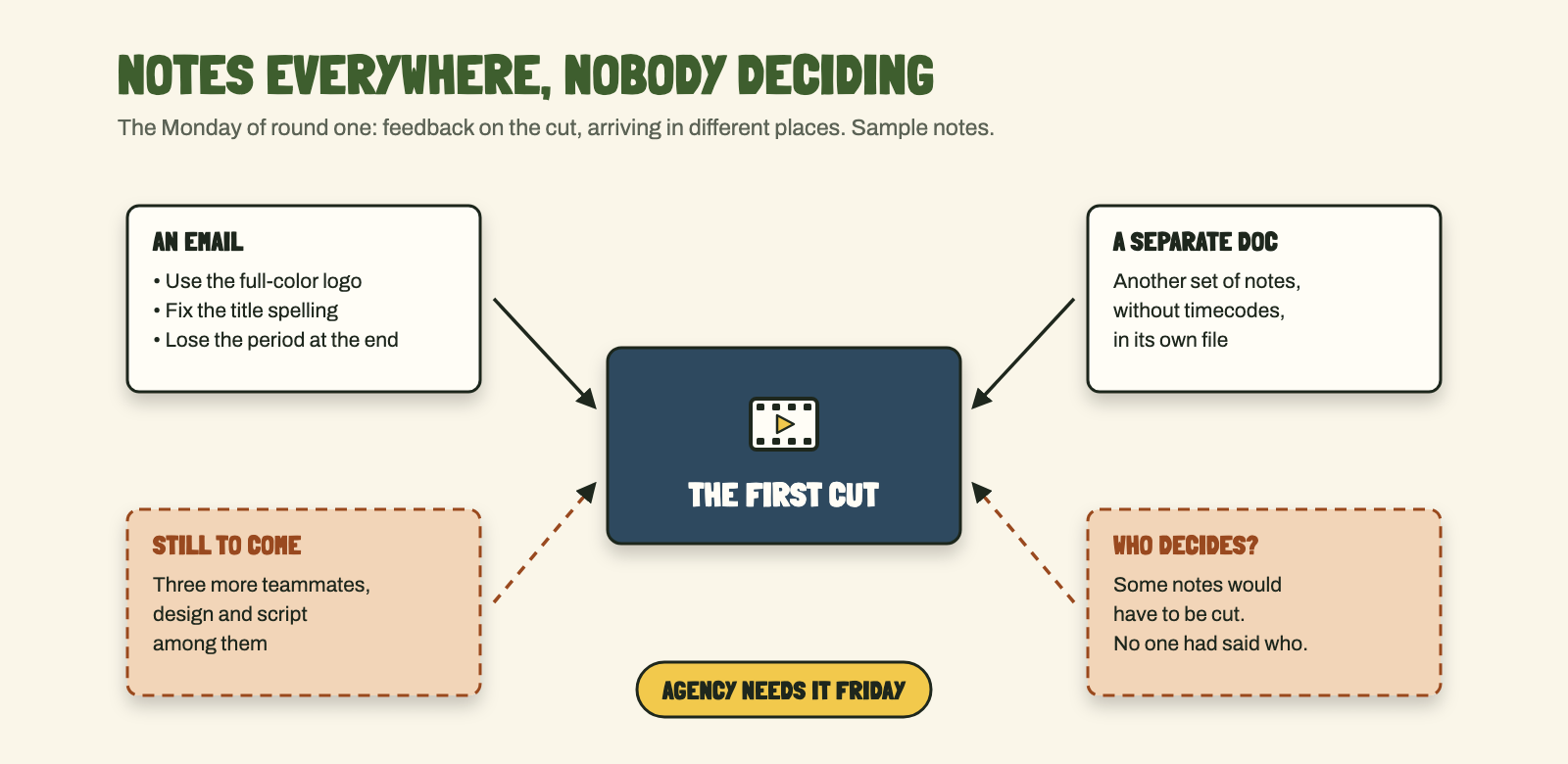
The first cut came in on Monday, April 1, and the notes started arriving in different places. Our director sent a list of bullets by email. Another colleague sent a separate document. Three more teammates still had to weigh in, and the agency needed one clear set of notes by Friday.
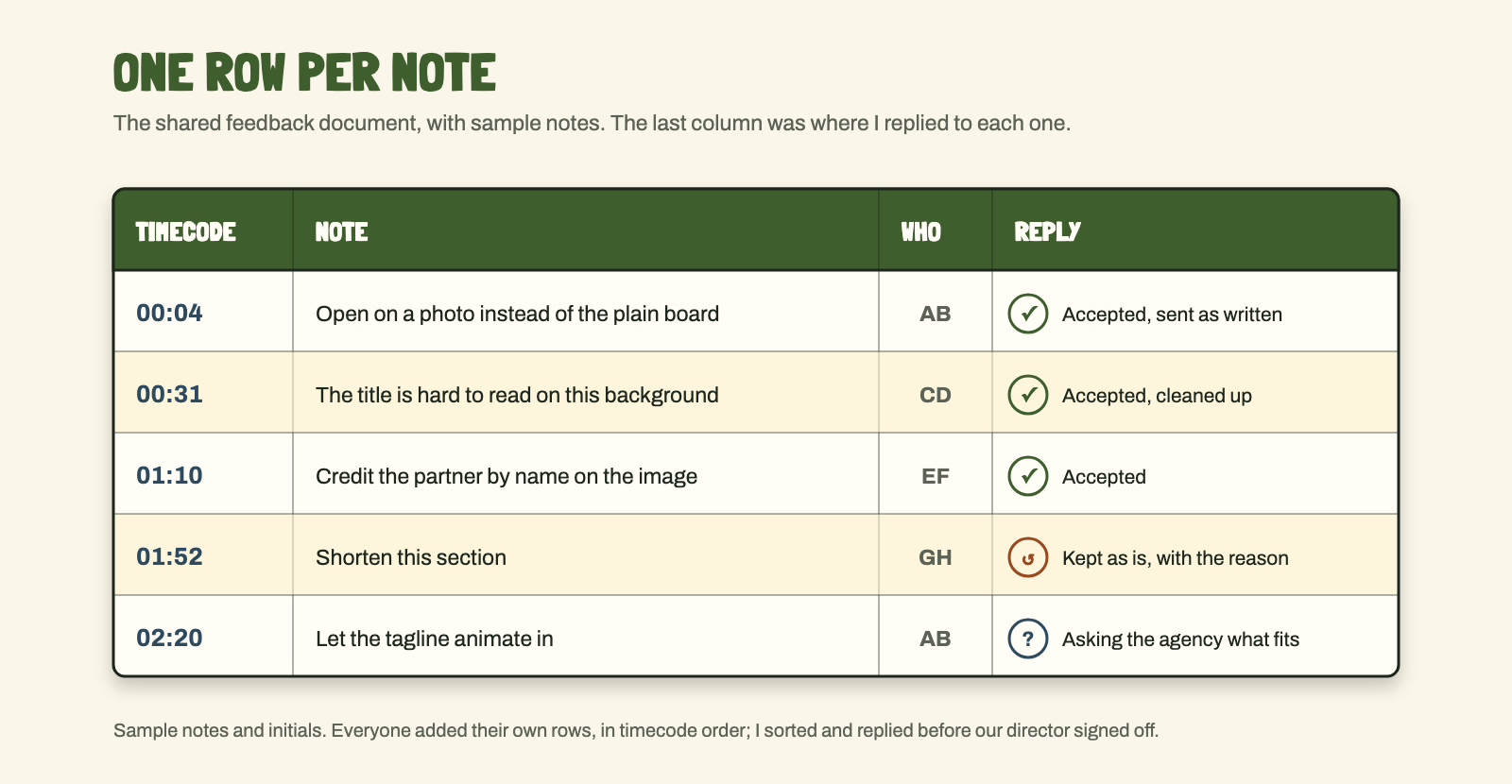
So I set up a shared document and asked everyone to add each note as its own row, with their initials, the timecode and the comment. I copied in the notes people had already sent by email so nothing was lost. Then I asked everyone to edit the document directly instead of replying to the thread.
DECIDE WHO DECIDES
Our creative lead asked me a fair question. If I was pulling everyone's feedback into one set of notes, some of it would get cut. Who was going to make that call? Our director and I agreed to weigh each note by who owned that part of the work. Design notes leaned on our creative lead, and script notes leaned on the teammate who owned the script. I took two days to sort the notes, accept or reject each one and reply to it. Our director signed off on Friday, and the cleaned-up list went to the agency that day.
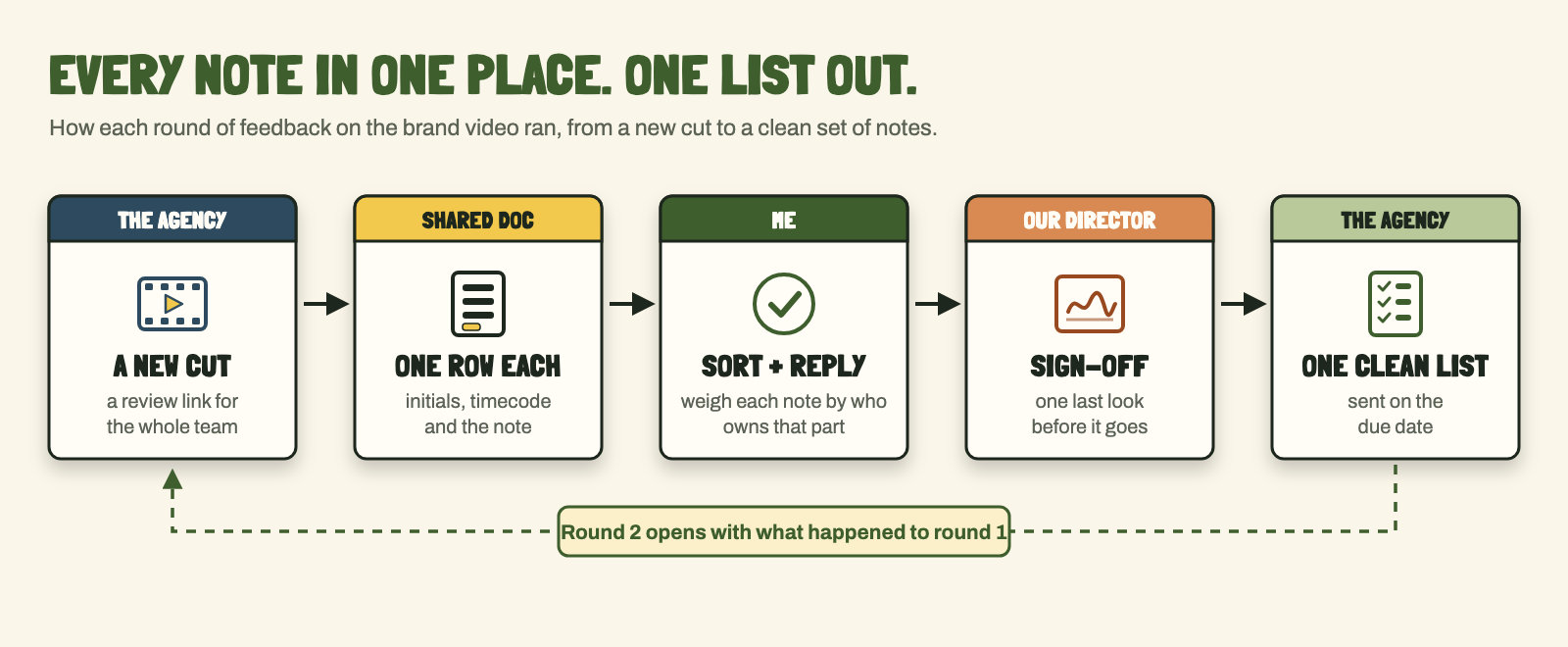
For the second cut, I opened a new document with a summary at the top. It linked the notes we'd sent the first time, so everyone could see how their comments had been used. Most went in word for word or lightly cleaned up. Where we kept something a teammate had asked to change, I explained why.
TRANSLATE BETWEEN THE EDIT AND THE EXECUTIVES
Near the end, our CEO liked the video but wanted a different color filter, to match another interview in the same video. Her interview had been shot in our office with daylight, and the other had no natural light at all. I explained that, as far as I'd seen during filming, the same color settings had been applied to every shot, and the difference came from the light. Then I asked the agency for a color-graded version before we approved anything. Our director's reply: "This is very helpful information that I didn't know, not being a video editor."
UNDER THE HOODThe brief, the shoot and the feedback documents
- Agency calls: weekly calls with BerlinRosen's team, with Tides staff joining as each agenda needed. The video's script and interview questions lived in shared Google Docs that our script owner reviewed.
- Shoot: two days in San Francisco in February 2024, during the all-staff retreat week. Each executive was recorded for at least 30 minutes for a two-minute video. When the retreat team offered to pair their photo waiver with the agency's video release, I sent them the agency's form.
- Feedback documents: shared Word documents in SharePoint, one per round, with columns for timecode, comment and initials. Round 2 opened with a summary and links to round 1.
- Who decides: notes weighed by the project's RACI (who's responsible, accountable, consulted and informed): design to the creative lead, script to the writer, final sign-off to the director.
- Photos: pulled from a library folder of images already cleared with media releases. I checked which kinds of partners the cut's photos showed against our CRM and sent more cleared photos to balance them. The agency blurred visible name tags.
- Hosting: the final 1080p file was 336 MB, more than our website's 100 MB upload limit, so I uploaded it to YouTube and gave our web team the embed code.
What changed
After the shoot, our director thanked the crew and me: "Everyone enjoyed the filming experience." Both rounds of notes went to the agency on their due dates. After the first round, their senior producer wrote back: "Thank you again for the thoughtful (and very organized!) feedback."
The video was on the About page by mid-May 2024, about two weeks later than we'd planned. I'd pushed to approve it sooner so the agency could start on the social media cuts. Our director held it until our CEO had seen it, and then the agency did the color grading. Holding it was understandable, but it added delays. No other notes came in, so we could have started the social cuts and nothing would have changed.
I also pushed for us to get the raw footage. The agency had recorded at least 30 minutes with each executive to make two minutes of video. Our team got the raw files in 2025, and I re-edited the video that spring. It was a simple cut, and that version is the one on Tides' YouTube channel.
Looking back
In December 2023, I told my team I liked that everyone could add feedback to one shared document instead of a few people deciding in private. I still do. What I'd change is deciding who makes the final call before the notes come in. That person, whether it's the project manager or a creative director, should be able to make editorial choices once they've reviewed the notes, without waiting on more rounds of approval.
The raw footage is the same lesson. At the start, nobody had said clearly how we'd get it. As more people joined separate conversations about the video, it got even less clear. Next time, I'd settle both in the plan on day one.